Abstract
We uuse causal normalizing flows (CNFs) to enable the out-of-distribution (OOD) exploration wherein the policy can be optimized without performance degradation. Specifically, we use the model to learn the transition dynamics and reward function for data generation and augmentation in offline policy learning. Given the physics-based qualitative causal graph and precollected data, we develop a model-based offline OOD-adapting causal RL (MOOD-CRL) algorithm.
Key Contributions
- Optimization framework: We propose a model architecture that uses a bijective CNFs for learning transition dynamics and a reward function and design a policy optimization framework where we use online policy optimization algorithm with OOD exploration.
- Improved performance: We showed that our algorithm outperforms existing model architecture with significant margin and robustness.
- Extensive ablation: We showed ablation studies how our framework is resilient to data quality, sophstication of algorithm (e.g., REINFORCE vs PPO), and include interpretable results on OOD predictive power using discrete environments.
Method Overview — MOOD-CRL
The core problem we tackle is how to leverage bijective causal normalizing flows (CNFs)—where input and output dimensions must strictly match—to predict transition dynamics and reward functions.
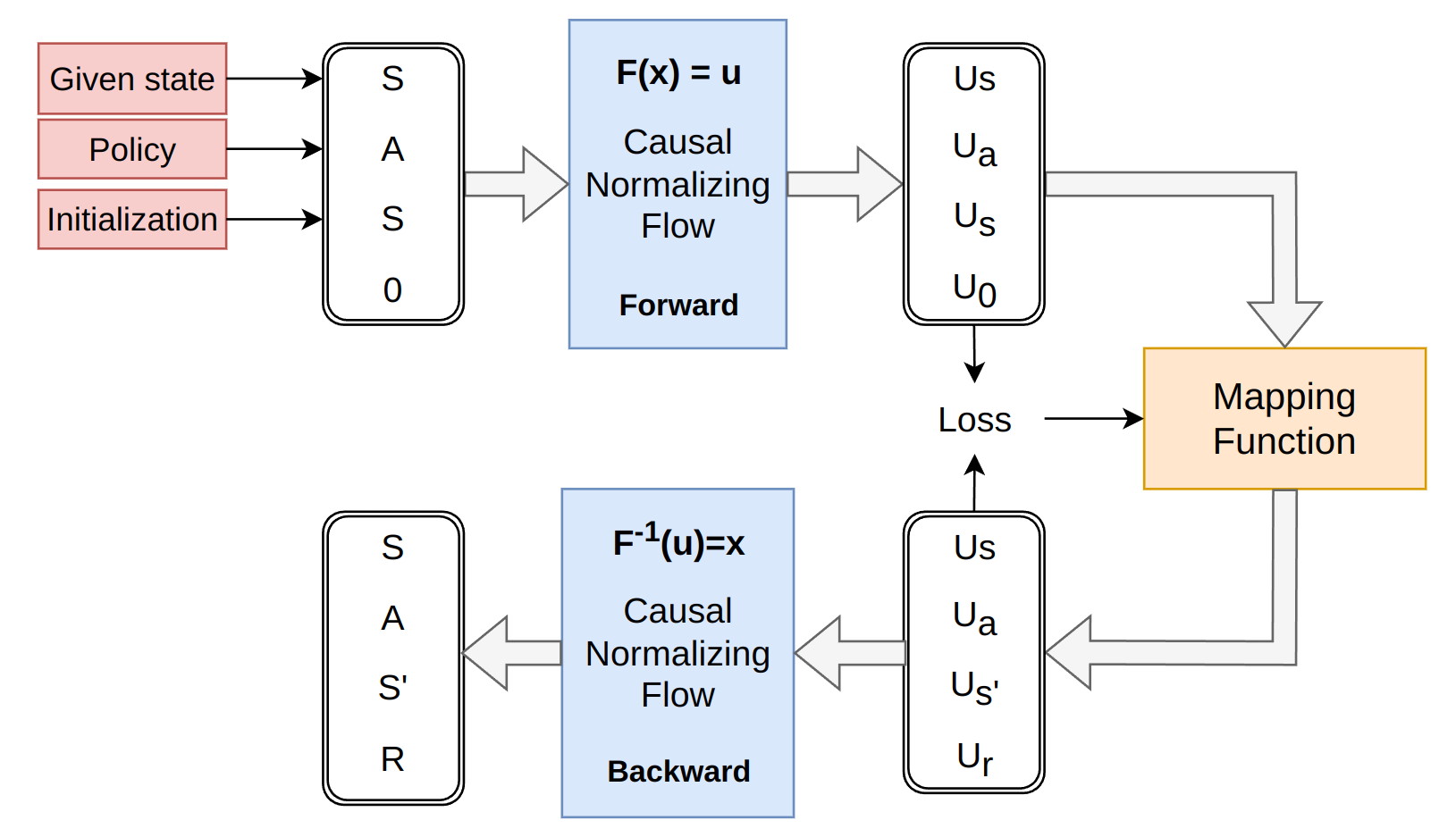
Figure 1: Architecture of the Causal Normalizing Flow for predicting next-state dynamics and rewards.
The challenge lies in the bijective constraint: to predict the next state \(s'\) and reward \(r\), the model theoretically requires an input of the same dimensionality. However, these values are exactly what we aim to estimate.
- Next State (\(s'\)): We provide the current state (\(s\)) as the input token, utilizing the inductive bias that \(s'\) is typically similar to \(s\) in continuous MDPs.
- Reward (\(r\)): We "void out" the reward input by setting it to zero to create a neutral starting token.
By training the CNFs to map this specific input (current state and zero-reward) to the ground-truth target (actual next state and actual reward) from the offline dataset, the flow learns to accurately model the underlying transition manifold while satisfying the bijective requirement.
Cite this work
Cho, M., & Sun, C. (2025). "Out of Distribution Adaptation in Offline RL via Causal Normalizing Flows." Mathematics, 13(23), 3835.
@article{cho2025out,
  title={Out of Distribution Adaptation in Offline RL via Causal Normalizing Flows},
  author={Cho, Minjae and Sun, Chuangchuang},
  journal={Mathematics},
  volume={13},
  number={23},
  pages={3835},
  year={2025},
  publisher={MDPI}
}
Discussion
No comments yet.